

MA-ID: 1718902018
Évaluations Enumismatics Inc.

Hurtig levering fin mønt
die beste Verkäufer, super Verpakung, turbo Lieferung, immer wieder!!!!
die beste Verkäufer, super Verpakung, turbo Lieferung, immer wieder!!!!
die beste Verkäufer, super Verpakung, turbo Lieferung, immer wieder!!!!
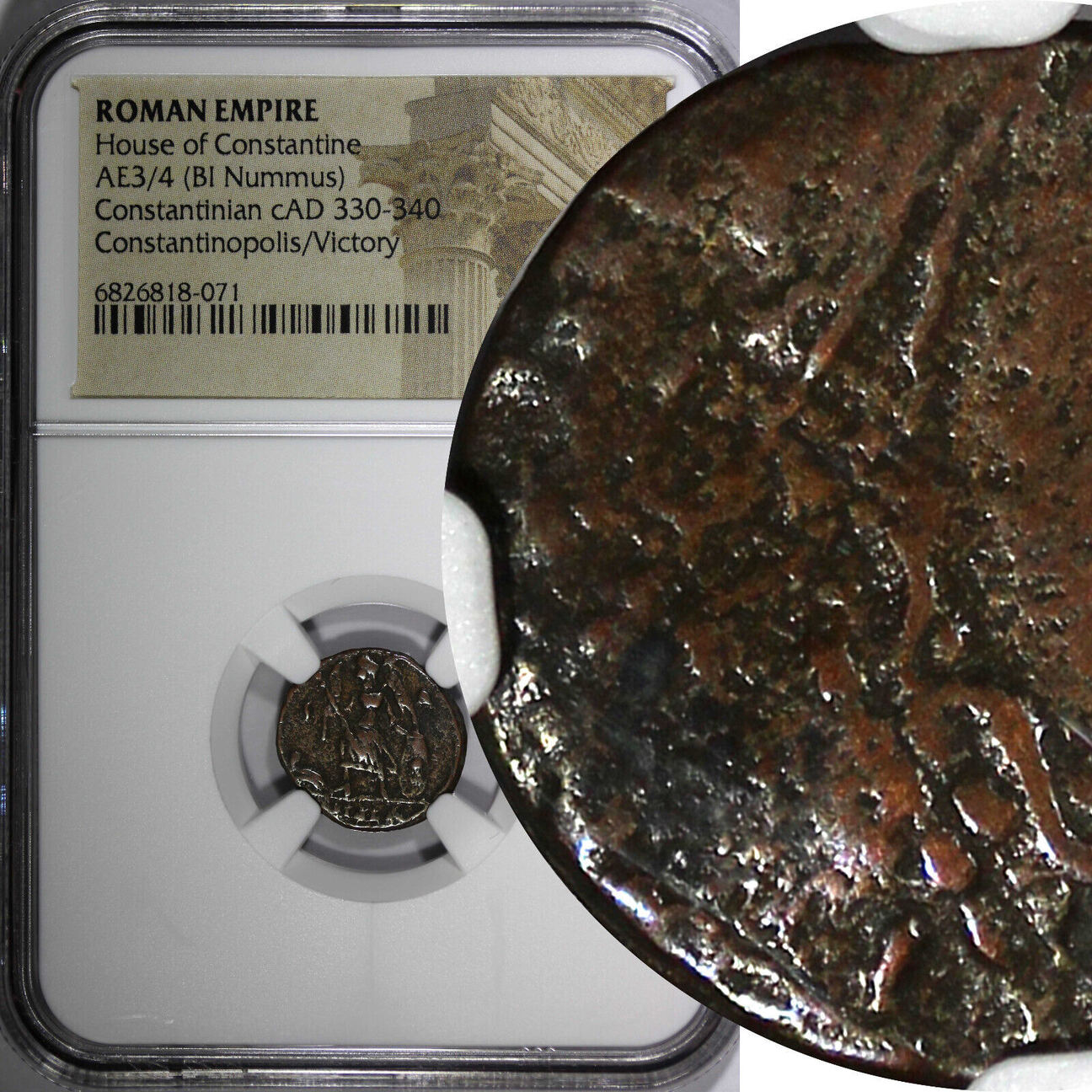
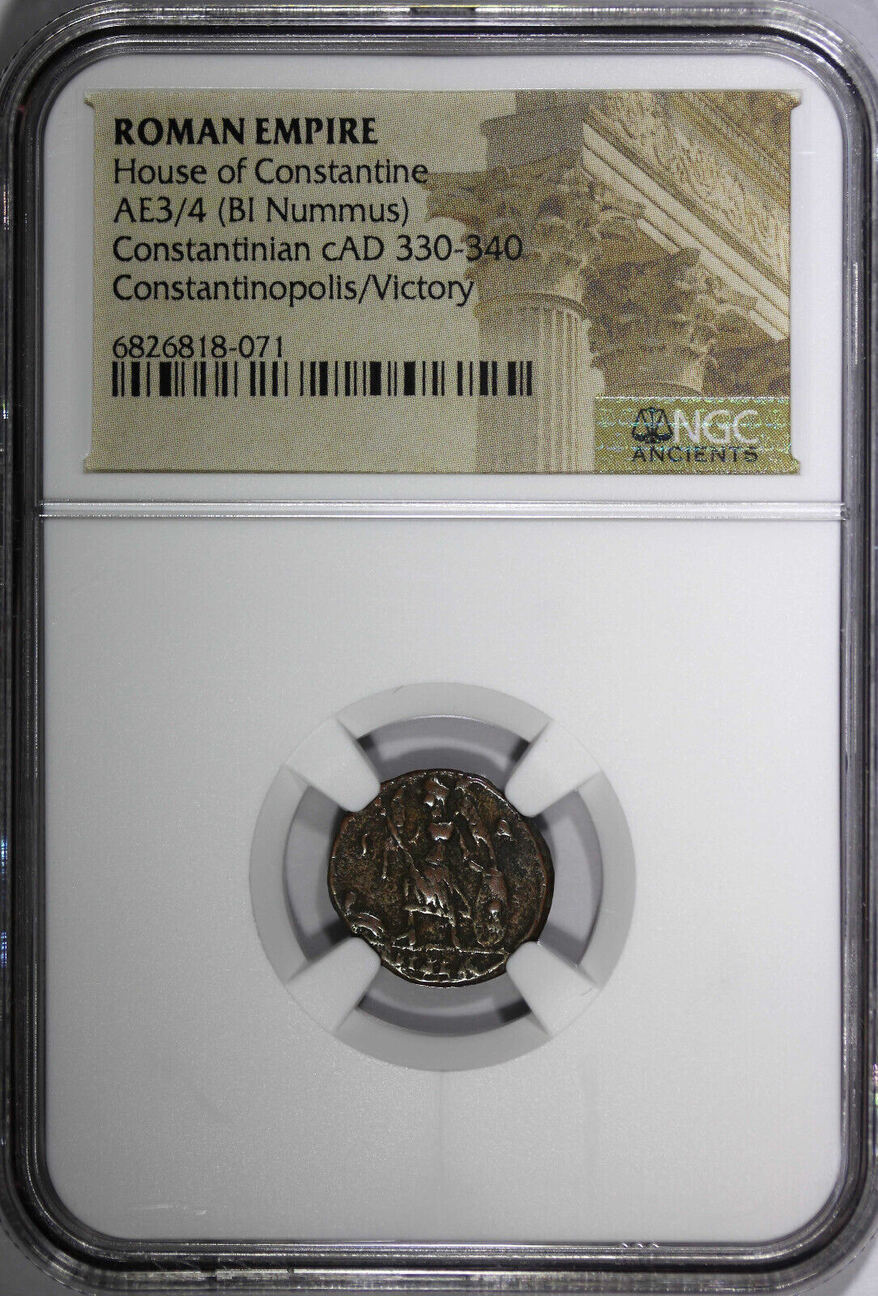
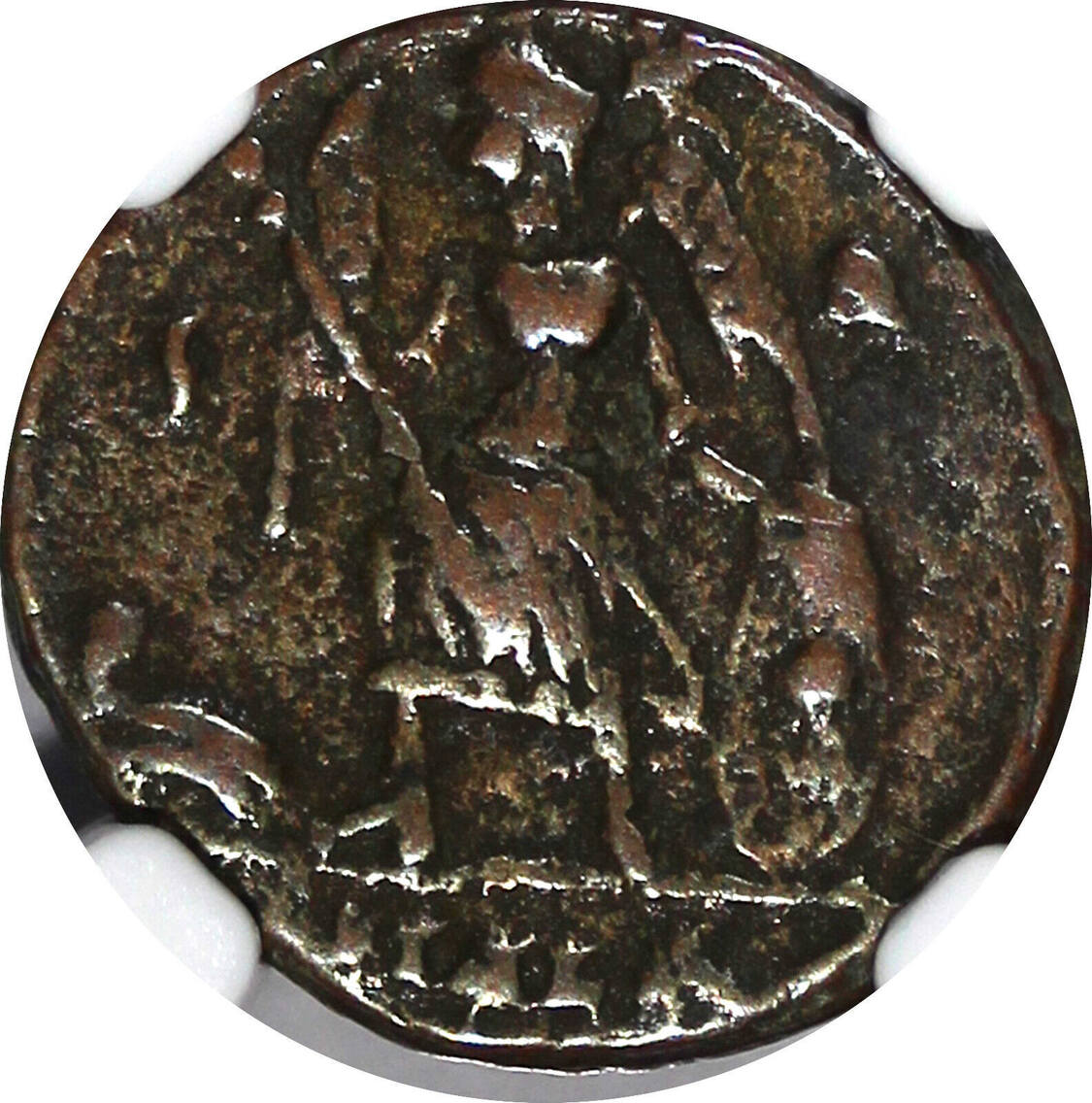
NUMMUS 330 après J.-C. Roman Constantinian AD 330-340 AE3/4 NGC Rev.Constantinopolis/Victory (1)
Enumismatics Inc. 
11
Sur MA-Shops depuis 11 années
1279 évaluations,
100 % Positif ( derniers 24 mois )
Expédition dans le monde entier
35,69 EUR40.00 US$
En cas de commandes internationales, le client doit payer, en cas échéant, la TVA et des droits de douane.
+ 17,84 EUR frais d'envoi ( vers France métropolitaine )
Délai de livraison : 5 à 8 jours
+ 17,84 EUR frais d'envoi ( vers France métropolitaine )
| +49 (0)2871 2180 383 |
| Modes de paiement |
| virement bancaire |
| Chèque/Money Order |
 Certification
793469
Constantinopolis/Victory
House of Constantine ROMAN EMPIRE
AE3/4 (BI Nummus)
ROMAN EMPIRE
Constantinian cAD 330-340
House of Constantine
REIGN OF THE EMPEROR CONSTANTINIAN AD 330-340
AE3/4 BI NUMMUS (FOLLIS)
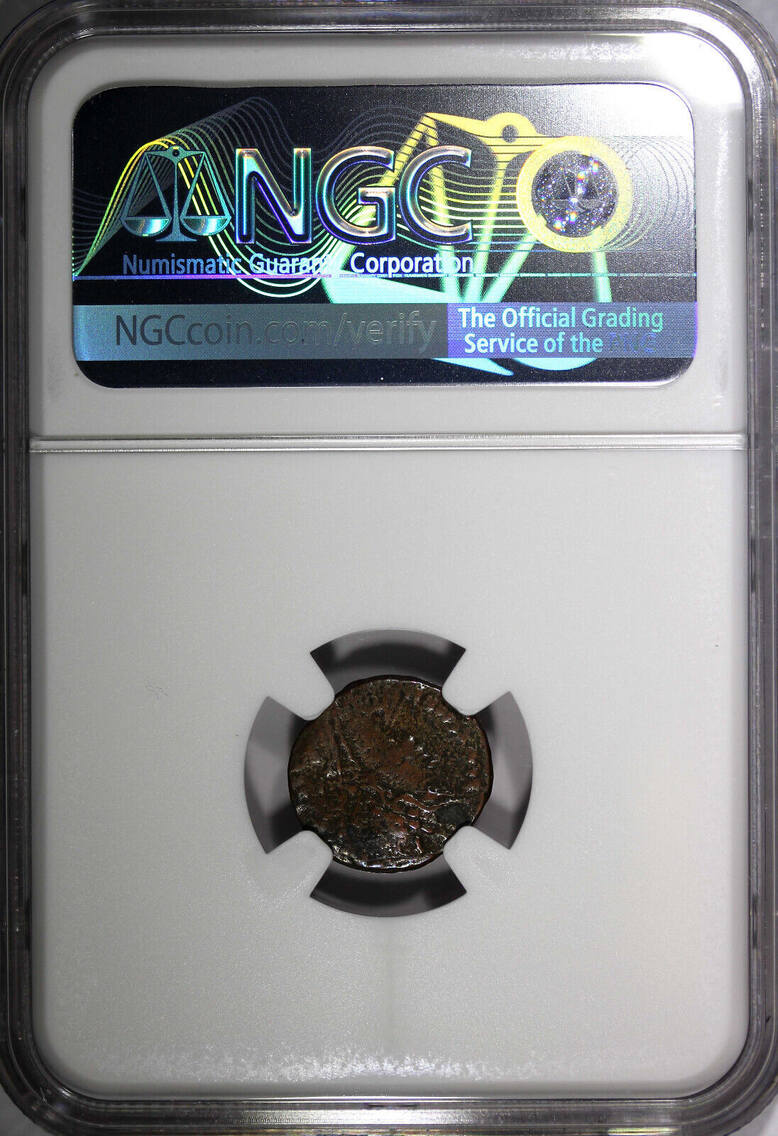
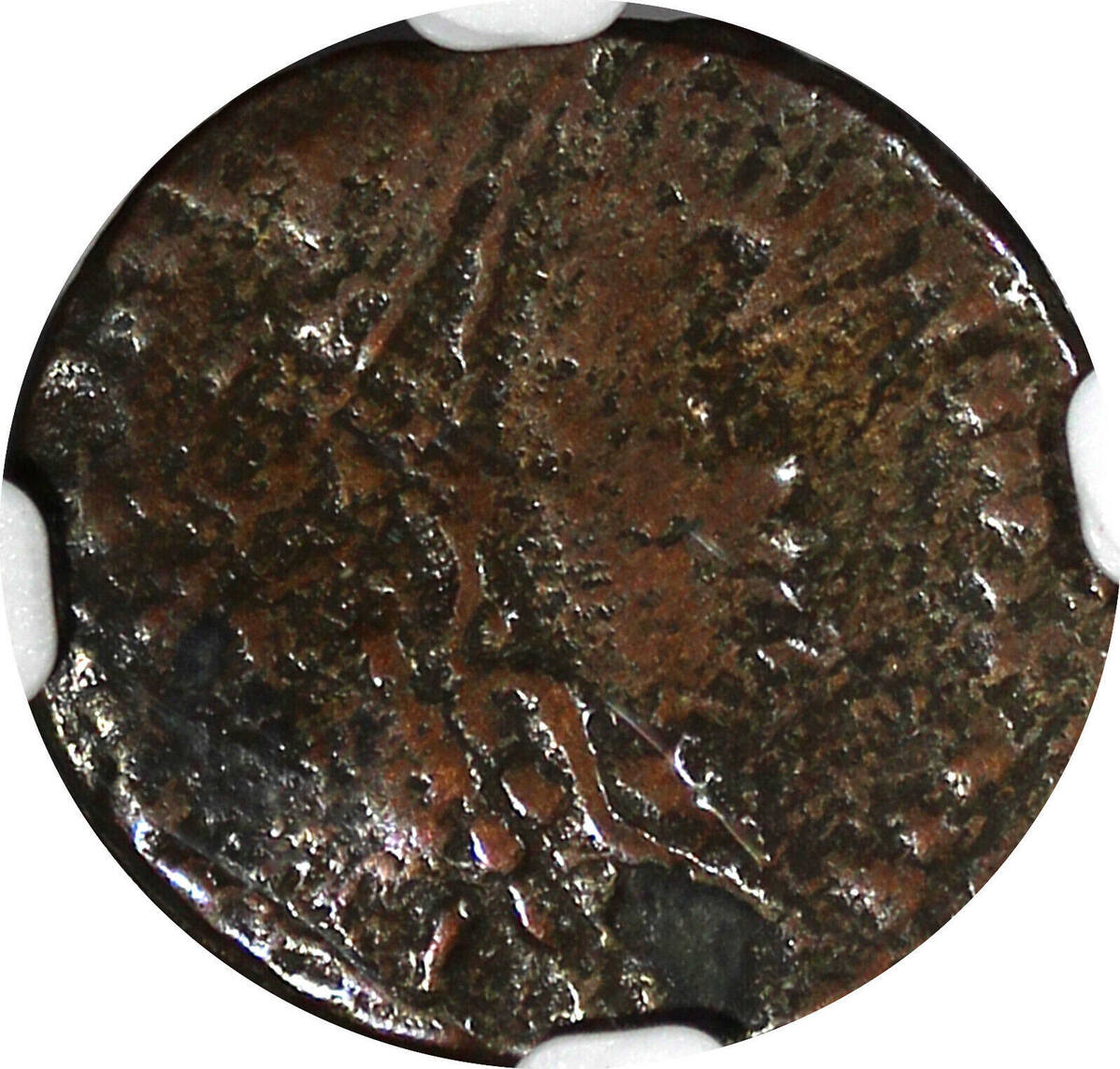
OBVERSE: LAUREATE AND ARMORED BUST OF
CONSTANTINIAN RIGHT.
REVERSE: CONSTANTINOPOLIS / GOD VICTORY.
This coin was issued by Constantine the
Great to commemorate the founding of the city of Constantinopolis.
The obverse of the coin features a helmeted
goddess while the reverse features a Guardian Angel
By circa 330 A.D., Constantine the Great
completed his new capital for the Roman empire and called it Constantinople
after himself, originally the ancient Greek city named Byzantium. Constantinople
lay in a strategically important location and could be considered the
continuation of the Roman empire in the east until about 1453 A.D. when it fell
to the Ottoman Turks. For this momentous occasion, he issued two coin types
commemorating this event, with one celebrating Rome and the other
Constantinople. The type that commemorated Rome had the personification of Rome,
Roma with the inscription VRBS ROMA and the founders of Rome, Romulus and Remus
on the reverse suckling the mythical she-wolf. The type that commemorated
Constantinople had the personification of Constantinople on the obverse and
Victory on a galley sailing with a shield. This was a great way for Constantine
the Great to pay homage to both Rome and Constantinople as now the Roman empire
had two official capitals.
Constantinopolis, built on the site of the ancient Byzantium by Constantine the
Great, who called it after his own name and made it the capital of the Roman
empire. It was solemnly consecrated A.D. 330. It was built in imitation of Rome.
Thus it covered 7 hills, was divided into 14 regiones, and was adorned with
various buildings in imitation of the capital of the Western world. Its extreme
length was about 3 Roman miles ; and its walls included eventually a
circumference of 13 or 14 Roman miles. It continued the capital of the Roman
empire in the east until its capture by the Turks in 1453.
Constantine I 'The Great' - Roman Emperor:
307-337 A.D.
Caesar (Recognized): 306-309 A.D. | Filius Augustorum (Recognized): 309-310 A.D.
| Augustus (Self-Proclaimed): 307-310 A.D. | Augustus (Recognized): 310-337 A.D.
|
| Son of Constantius I 'Chlorus' and Helena | Step-son of Theodora | Husband of
Minervina and Fausta | Father (by Minervina) of Crispus and (by Fausta) of
Constantine II, Constantius II, Constans, Constantina (wife of Hanniballianus
Constantius Gallus) and Helena the Younger (wife of Julian II) | Son-in-law of
Maximian and Eutropia | Brother-in-law of Maxentius | Half-brother of Constantia
(w. of Licinius I) | Half-uncle of Delmatius, Hanniballianus, Constantius
Gallus, Julian II, Licinius II and Nepotian | Grandfather of Constantia (wife of
Gratian) |
Constantine the Great (Latin: Flavius Valerius Aurelius Constantinus Augustus;
27 February c. 272 AD - 22 May 337 AD), also known as Constantine I or Saint
Constantine (in the Orthodox Church as Saint Constantine the Great,
Equal-to-the-Apostles), was a Roman Emperor from 306 to 337 AD. Constantine was
the son of Flavius Valerius Constantius, a Roman army officer, and his consort
Helena. His father became Caesar, the deputy emperor in the west in 293 AD.
Constantine was sent east, where he rose through the ranks to become a military
tribune under the emperors Diocletian and Galerius. In 305, Constantius was
raised to the rank of Augustus, senior western emperor, and Constantine was
recalled west to campaign under his father in Britannia (Britain). Acclaimed as
emperor by the army at Eboracum (modern-day York) after his father's death in
306 AD, Constantine emerged victorious in a series of civil wars against the
emperors Maxentius and Licinius to become sole ruler of both west and east by
324 AD.
As emperor, Constantine enacted many administrative, financial, social, and
military reforms to strengthen the empire. The government was restructured and
civil and military authority separated. A new gold coin, the solidus, was
introduced to combat inflation. It would become the standard for Byzantine and
European currencies for more than a thousand years. The first Roman emperor to
claim conversion to Christianity, Constantine played an influential role in the
proclamation of the Edict of Milan in 313, which decreed tolerance for
Christianity in the empire. He called the First Council of Nicaea in 325, at
which the Nicene Creed was professed by Christians. In military matters, the
Roman army was reorganised to consist of mobile field units and garrison
soldiers capable of countering internal threats and barbarian invasions.
Constantine pursued successful campaigns against the tribes on the Roman
frontiers-the Franks, the Alamanni, the Goths, and the Sarmatians-even
resettling territories abandoned by his predecessors during the Crisis of the
Third Century.
The age of Constantine marked a distinct epoch in the history of the Roman
Empire. He built a new imperial residence at Byzantium and renamed the city
Constantinople after himself (the laudatory epithet of ''New Rome'' came later,
and was never an official title). It would later become the capital of the
Empire for over one thousand years; for which reason the later Eastern Empire
would come to be known as the Byzantine Empire. His more immediate political
legacy was that, in leaving the empire to his sons, he replaced Diocletian's
tetrarchy with the principle of dynastic succession. His reputation flourished
during the lifetime of his children and centuries after his reign. The medieval
church upheld him as a paragon of virtue while secular rulers invoked him as a
prototype, a point of reference, and the symbol of imperial legitimacy and
identity. Beginning with the Renaissance, there were more critical appraisals of
his reign due to the rediscovery of anti-Constantinian sources. Critics
portrayed him as a tyrant. Trends in modern and recent scholarship attempted to
balance the extremes of previous scholarship.
Constantine is a significant figure in the history of Christianity. The Church
of the Holy Sepulchre, built on his orders at the purported site of Jesus' tomb
in Jerusalem, became the holiest place in Christendom. The Papal claim to
temporal power in the High Middle Ages was based on the supposed Donation of
Constantine. He is venerated as a saint by Eastern Orthodox, Byzantine
Catholics, and Anglicans.
Please check out my other listings and we will be happy to combine in one package !
YOU WILL RECEIVED THE SAME COIN AS PICTURED.

Shipping Info
Les ventes en ligne sont possibles, les livraisons internationales peuvent être un peu plus longues.
|
Renoncer au contrat ici Page d'accueil de cette boutique | 0Panier | CGV | Mentions légales | MA CGV | Déclaration de protection de données | Garantie | MA-Shops Nouveautés Copyright ® 2001-2026, MA-SHOPS Coins All Rights Reserved. Designated trademarks and brands are the property of their respective owners. |